

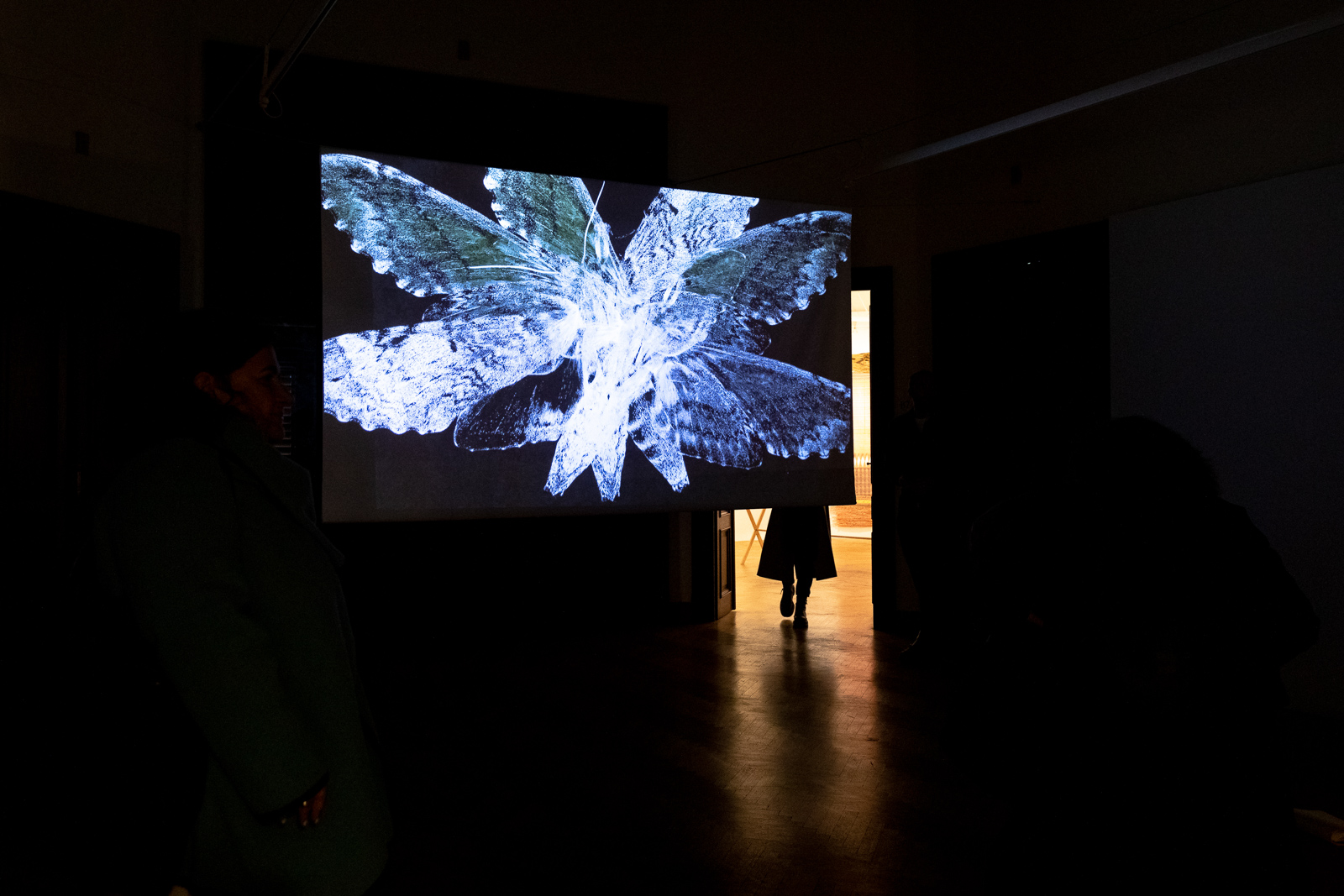
4 March 2023 - 21 May 2023
8TH BIENNALE OF CONTEMPORARY ART OF THESSALONIKI
The main exhibition of the 8th Thessaloniki Biennale of Contemporary Art entitled “Being as Communion” opened on Saturday 04 March. The exhibition lasts until 21 May 2023 and is presented in ten different locations, museums, monuments and spaces of the city, linking buildings from critical periods of Thessaloniki’s history – Byzantine, Ottoman, modern – and proposing at the same time a polyphonic reading but also a coupling of many equal voices.
Without a central exhibition space, the main exhibition can be described as multi-polar, as each space – the MOMus Museum of Contemporary Art, the Archaeological Museum of Thessaloniki, the Museum of Byzantine Culture, the National Bank of Greece Cultural Foundation, the Islahaneh Cultural Centre, the Eptapyrgion, the Yeni Mosque, the Pasha’s Gardens, the Glass Pavilion “Sculpture Garden” (beach), and the M2 building of the Thessaloniki Concert Hall – operates autonomously, allowing the visitor to imagine a variety of connections.
The exhibition “Being as Communion” retraces and hosts the works -new and past productions- of 28 artists and artistic groups who have indeed tried alternative paths, projecting resistance to their lives and practices, focusing on various forms of intercourse between different subjects, living and dead, species and environments.
Artists: Jumana Emil Abboud, Paki Vlassopoulou, Gianfranco Baruchello, Campus Novel, Aslı Çavuşoğlu, Phoebe Giannisi, COYOTE, Cevdet Erek, Zheng Bo, Piero Gilardi, Sky Hopinka, Akira Ikezoe, Vasso Katraki, Jumana Manna, Ahmed Morsi, Hira Nabi, Abraham Onoriode Oghobase, Yannis Papadopoulos, Alexandra Paperno, Angelos Plesas, Iva Radivojević, Kostas Roussakis, Corinne Silva, Panos Sklavenitis, Agnès Varda, Ana Vaz, Vessel (Navine G. Dossos and James Bridle), Thanasis Xondros & Alexandra Katsiani
Edited by Maria-Thalia Karra
Assistant Curators: Fotini Salvaridis, Manto Psarelli
Production Coordination: Thodoris Markoglou, Katerina Syroglou
Architectural design: Evita Fanou
Catalogue authors: Tristan Bera, Phoebe Giannisi, Maria-Thalia Karra, The Architects of the Whale
Catalogue design: Studio Lalios Vazoura
The artists of the exhibition “Being as Communion” by space
Archaeological Museum of Thessaloniki*
Artists.
At the Archaeological Museum of Thessaloniki, Phoebe Giannisi’s work, Black of Bones**, is an acoustic walk in dialogue with the museum’s open-air exhibition entitled Field, House, Garden, Place, which gives the public the opportunity to visit the residences and cemeteries of the ancient city and listen to stories of coexistence with our dark earth. The archival exhibition Agricola Cornelia S.p.A. by Gianfranco Baruchello is a testimony to the work of a pioneering artist whose artistic production was identified with the land he cultivated. Cevdet Erek’s two-panel work, Stis Thessaloniki’s Two Courts / Selanik’te var iki avlu, is a response to the architectural modernism of the museum and all that it implies, in dialogue with the artist’s other sculptural intervention in the neighbouring Museum of Byzantine Culture. The work of the COYOTE collective, Absence is the Highest form of Presence refers to texts quoted translated into Greek and English, as well as the lost languages of Thessaloniki – Ladino and Ottoman Turkish.
National Bank Foundation), the Pasha’s Gardens.
*Magnoli Andronicus 6
Opening hours: Until 31 March: Monday, Tuesday, Wednesday, Thursday, Friday, Saturday, Sunday 08:30-15:30. From 1 April: Monday, Tuesday, Wednesday, Thursday, Friday, Saturday, Sunday 08:00-20:00
{%CAPTION%}
———-
Museum of Byzantine Culture*.
Artists.
The Museum of Byzantine Culture is a landmark in itself, being one of the most famous public buildings in Greece for its architecture. Designed by the architect Kyriakos Krokos, it is one of the starting points for some of the works in the exhibition, such as those by Cevdet Erek and Kostas Roussakis, which are on display at the museum.
Other works are in dialogue with the museum’s collection: Jumana Manna’s Sketch and Bread parallels the structural fragments of modern cities with archaeological rubble. Ahmed Morsi’s surrealist panoptic vision is surrounded by Byzantine imagery, while Angelos Plessas imagines a new pattern of existence that combines mystical, Byzantine and futuristic elements with the digital.
*Leforos Stratos 2
Opening hours: Until 31 March: Monday, Tuesday, Wednesday, Thursday, Friday, Saturday, Sunday 08:30-15:30. From 1 April: Monday, Tuesday, Wednesday, Thursday, Friday, Saturday, Sunday 08:00-20:00
———-
Artist: Zheng Bo
Zheng Bo’s Drawing Life series is a meditative form of recording time, an invitation to an effortless, warm look at each individual drawing, each depiction of nature. As it is presented in the Glass Pavilion, overlooking the sea, and in dialogue with the natural world, the Drawing Life series functions almost as a solo exhibition in the context of the main exhibition of the 8th Thessaloniki Biennale of Contemporary Art.
*Paralia, Alexander the Great Avenue & Filippou Nikoglou
Opening hours: Tuesday, Wednesday, Thursday, Thursday, Friday, Saturday, Sunday 12:00-18:00
Islahane Cultural Centre*
Artists: COYOTE, Panos Sklavenitis, Agnes Varda, Vessel (James Bridle & Navine G. Dossos)
At Islahané, visual artist Panos Sklavenitis, filmmaker Agnes Varda and the art collective Vessel (James Bridle & Navine G. Dossos) present their works. All of them work with scarce materials that have been found, left behind, recycled. Each artist presents models of life in the form of small-scale or ephemeral acts of resistance to the status quo.
The Islahane was founded as an institution for destitute orphaned children of all religions, who were trained there in some art.
Exploring the form that a “technical school” would take in our time, oriented towards independent living, which would teach students techniques to create objects on their own with recycled or found materials, Vessel, in collaboration with architecture students from the University of Thessaloniki, designed the Super Kiosk, for tea and reflection.
Agnes Varda, in Les Glaneurs et La Glaneuse, tells the story of what is left behind (people, places, materials, food, film), giving them a leading role in her film.
Panos Sklavenitis, in #thehead | On becoming an Animal, also works on the margins, with the transformative and transgressive, creative and transgressive freedom that only disguise can offer.
The work of the COYOTE collective, Absence is the Highest form of Presence is also based on found materials – texts quoted translated into Greek and English, as well as the lost languages of Thessaloniki – the lantino
and Ottoman Turkish. COYOTE’s audiovisual campaign is developed throughout the main exhibition, in venues such as the Museum of Byzantine Culture, the Archaeological Museum, the Yeni Mosque, the MOMus Museum of Contemporary Art, the Villa Kapantzi (Cultural Foundation of the National Hellenic Republic), the Museum of Contemporary Art, the Museum of Contemporary Art, the Museum of Contemporary Art, the Museum of Contemporary Art, the Museum of Contemporary Art and the Museum of Contemporary Art.
The National Bank of Greece), the Pasha Gardens.
*Eleni Zografou 2
Opening hours: Monday, Tuesday, Thursday, Friday 09:00-14:30 | Wednesday 09:00-20:00.
Thessaloniki Concert Hall (building M2)*
Artist: Kostas Roussakis
The work of Kostas Roussakis presented at the Thessaloniki Concert Hall (building M2) entitled “two thieves: as self” is part of a trilogy (Love your neighbour as yourself), which forms an imaginary line that runs through the city of Thessaloniki (the other two parts of the work are exhibited at the Genti Koule and the Museum of Byzantine Culture). It is an exploration of the sculptural possibilities of the shape of the cross. Placed in the foyer of the Megaron Music Hall, opposite the horizontal axis of the sea, this sculptural study here refers to the scenography, in a performative gaze towards, against and in common with the horizon that extends in front, and with the building of the Megaron Hall behind the work.
*March 25th and Beach
Hours of operation:
Monday, Tuesday, Wednesday, Thursday, Friday, Saturday, Sunday 10:00-18:00
———-
MOMus-Museum of Contemporary Art*.
Artists.
On the ground floor of the museum, works by Yannis Papadopoulos, COYOTE, Hira Nabi, Jumana Emil Abboud, Corinne Silva and Campus Novel are presented, which revolve around issues of land, conservation and care.
Iva Radivojević’s Aleph connects disparate places, people and spaces, weaving stories between them that suggest a physical and metaphysical interconnectedness that can be imagined, but also difficult to dismiss.
*Egnatia 154 (inside TIF-Helexpo)
Opening hours: Tuesday, Wednesday, Friday, Saturday, Sunday 10:00-18:00, Thursday 12:00-20:00.
———-
Cultural Foundation of the National Bank of Greece – Villa Kapantzi*.
Artists.
Aslı Çavuşoğlu, COYOTE, Piero Gilardi, Akira Ikezoe, Vasso Katraki, Abraham Onoriode Oghobase, Ana Vaz, Thanasis Chondros and Alexandra Katsiani, Aslı Çavuşoğlu, Piero Gilardi, Akira Ikezoe, Vasso Katraki, Abraham Onoriode Oghobase, Ana Vaz and Alexandra Katsiani. As a whole, they narrate ecological injustices, collective struggles, fervent collaborations and highlight the potential for transformation.
*108 Vasilissis Olga Street
Opening hours: Monday, Tuesday, Wednesday, Thursday, Friday 10:00-18:00
Eptapyrgio / Yenti Koule*
Artists: Kostas Roussakis, Ana Vaz, Paki Vlassopoulou
The Eptapyrgio, also known by its Turkish name Yedi Kule, is a Byzantine and Ottoman fortress located at the northeastern end of the Acropolis of Thessaloniki.
In the 1890s the fortress was converted into the city’s main prison, where prisoners were held regardless of gender or reason for conviction. New buildings were added on both sides of the walls to meet the needs of this new role of the fortress.
The Genti Koulé became infamous for the imprisonment of political prisoners there under Metaxas, the German Occupation, and in the post-war period, from the Civil War to the dictatorship. It remained in operation as a prison until 1989.
The artists Paki Vlassopoulou, Kostas Roussakis and Ana Vaz, present their works in different corners of the Genti Koulé, and with the
in their way they touch upon its function as a prison.
Vlassopoulou’s work, I Have Seen the Moon Rise on Both the Left and Right sides of the Sky is an in situ indoor and outdoor installation, developed in three different spaces of the building (in the entrance corridor, as well as in the interior and exterior of the upper left room), functioning as a study of the physical and psychological dimension of the prison condition.
The sculptural intervention by Kostas Roussakis entitled The Two Bandits: agapa in the left courtyard of the building is one part of the triptych of works presented in the exhibition spaces of the Biennale’s main exhibition
(along with Your Neighbour at the Museum of Byzantine Culture and As Myself at the Athens Concert Hall). It is a study on the axis of the cross, its charged symbolism, the implications of scale or the possibility of escape by leaping over the high walls of the prison.
Ana Vaz’s film Ha Terra! in the Teaching House (in the prisoners’ classroom) uses the location of the Yendi Koule as a vantage point to look at the city that stretches out below, raising questions and challenges about the filmic and architectural panoptics, the uses of
land use, colonialism and control.
*Eptapyrgios 130
Opening hours: Until 31 March: Monday, Wednesday, Thursday, Friday, Saturday, Sunday, 08:30-15:30
———-
Yeni Mosque*.
Artists: Alexandra Paperno
At Yeni Mosque, Alexandra Paperno’s work Abolished Constellations speaks of arbitrary systems, collective utopias and subsequent failures, in a building that reveals much about the history of Thessaloniki. Designed by the 19th-century Italian architect Vitaliano Poselli as a place of worship for the city’s Donmehs (Islamised Jews who followed the teachings of the 17th-century rabbi Shabbatai Zevi, who claimed to be the messiah, but eventually converted to Islam, while retaining elements of Jewish faith and Kabbalistic beliefs), later served as an archaeological museum, and for a time housed refugees from the 1922-1925 population exchange. These changes and transformations seem to contradict the certainty of the seemingly random selection of the stars forming the recognised constellations and the vagaries of the times.
*Archaeological Museum 30
Opening hours: Friday and Saturday 10:00-15:00
———-
Artists.
* Ano Polis, Eleni Zografou
Text of the main exhibition
The main exhibition of the 8th Thessaloniki Biennale of Contemporary Art, entitled Being as Communion, is a reflection on the theme of coexistence – coexistence with the people next to us, but also with the beyond the human, with the animals, the forests, the gardens of our land, with the shadows of the past, the dead and the generations to come.
The exhibition attempts to shed a dim light that will cut through the barrage of catastrophic predictions and the foggy uncertainty we are experiencing. It poses the question of whether we can imagine new forms of existence, new life processes, once we realise that this is only possible on condition of cooperation.
It looks back to artistic practices of the past, practices that envision ways of working with the earth, create radical pedagogical tools, pioneer ecological activism and broaden the horizon of our ways of coexistence. The contemporary works anticipate multiple forms of communion: with the fragile past of the city hosting the exhibition, with the forests, with the soil, with the people around us as well as other species. Understanding the element of indeterminacy, the twenty-eight artists, artists and art groups participating in the exhibition explore, question and provide their responses. These responses involve ruptures, seek to redress injustice and offer examples of understanding, affection and care with the artists envisioning multiple forms of organization, living and love.
Being as Communion bears witness to the challenges involved in trying to imagine alternative future paths for a city so rooted in the past. Thessaloniki, a city with 3,000 years of history – Hellenistic, Roman-Byzantine, Ottoman, modern – with all its moments of glory and failures, allows us to gain a broader conception of time. How can we talk about symbiosis, about our relationship with the future, in environments and cities where almost every trace of the ‘encounters’ of the past has been lost?
She identifies affinities with the ghosts of the city, seeking to coexist with them and retell their stories. It invites a rethinking of the coexistence of the living and the dead, but also of the human-animal-forest-plant coexistence that makes up our environment. The exhibition asks us to consider how the living world around us makes us feel, and how we in turn affect it. The purpose? In the time we have, to appreciate and rejoice in both the frictions and joys of our shared life.
Being as Communion is developed in ten different spaces, which function as small exhibition centres diffused throughout the city of Thessaloniki. Each space is associated with a specific period of the city’s history.
The Thessaloniki Biennale of Contemporary Art is co-funded by Greece and the European Union (European Regional Development Fund), organized by MOMus and implemented by MOMus-Museum of Contemporary Art-Collections of the Macedonian Museum of Contemporary Art and the State Museum of Contemporary Art.
Download the app


Powered by  © Copyright Thessaloniki Tourism Organization


